
Pleura-safe® safety pleural puncture kit
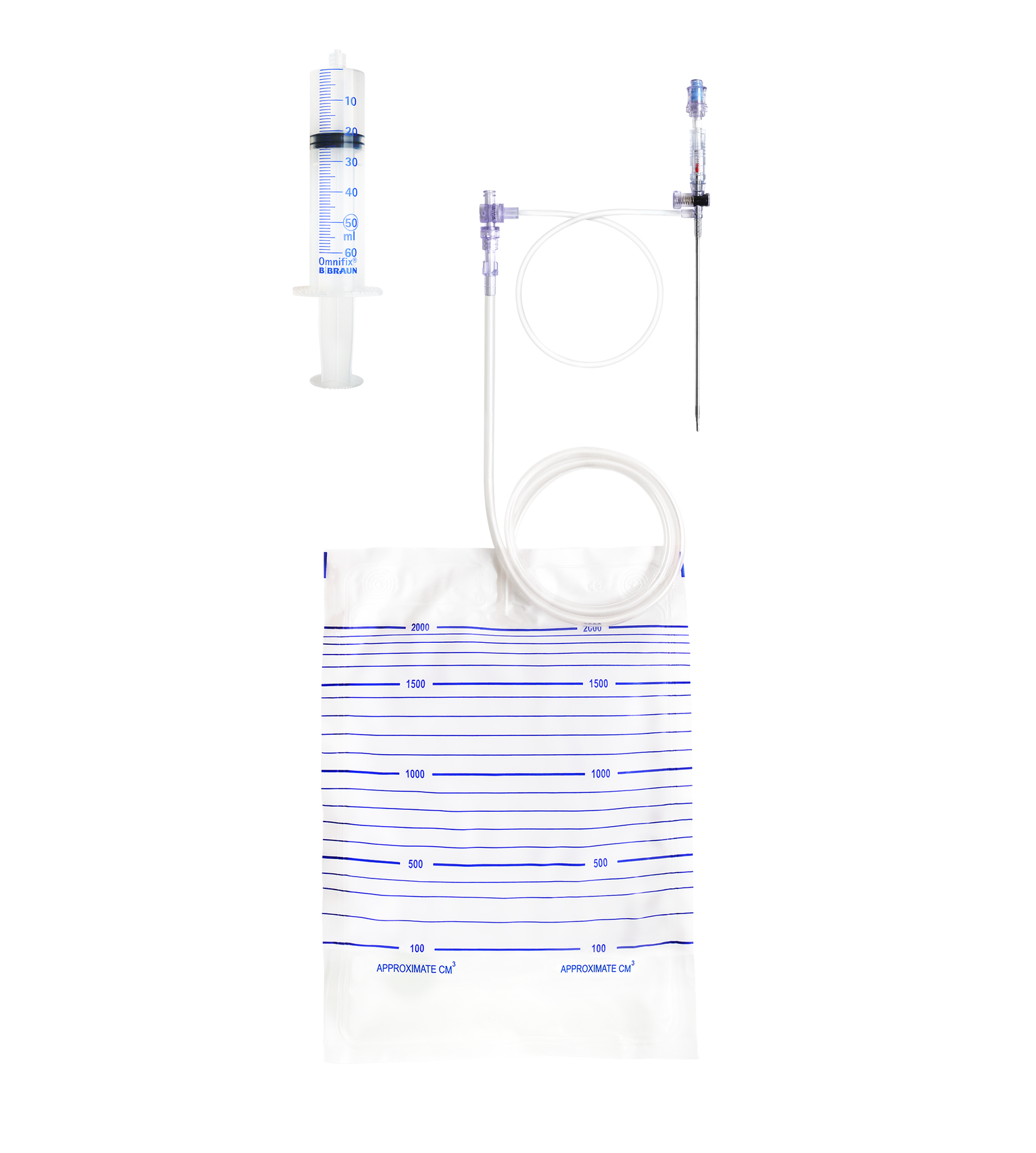
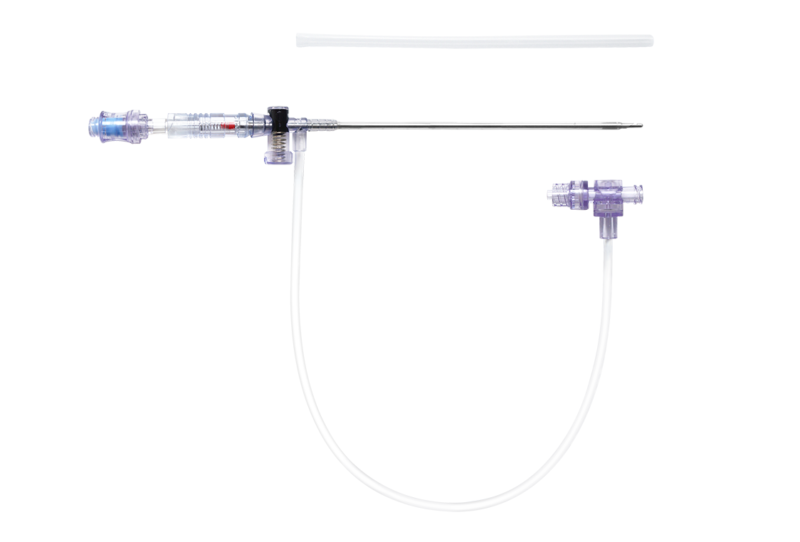
A closed system for aspiration of pleural fluid or air, consisting of a safety puncture needle (14 G × 170 mm), an 8 Fr radiopaque catheter and an automatic three-way valve. After puncture, the needle is removed and the catheter can remain in place for up to 30 days* for repeated drainage.
maximum indwelling time of the catheter (approx. one month)*
Repeated drainage through one catheter
For recurrent pleural effusions, the radiopaque catheter can be left in place temporarily as a Mini-Drain for up to 30 days*. Subsequent drainages are performed through the same catheter, so no further chest puncture is required.
According to the British Thoracic Society guideline for pleural disease, about one third of patients who receive pleural aspiration as the first intervention for malignant pleural effusion may need another procedure within two weeks.
Established practice in Europe and the USA
Pleura-safe® and similar safety puncture kits are well established in Europe and the USA, where they are the most common tool for a thoracentesis procedure. They are used for the following reasons.
Safety
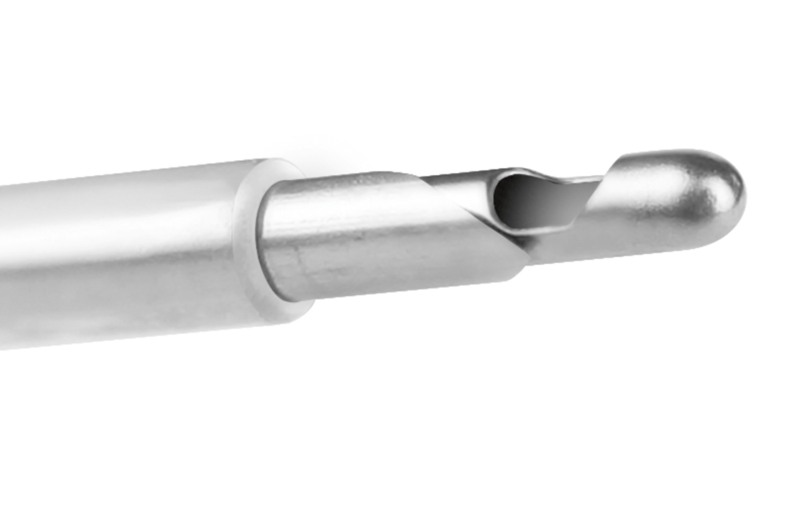
Safety needle with blunt cannula and a color indicator that confirms entry into the pleural cavity, designed to reduce the risk of iatrogenic pneumothorax.
Application
Percutaneous puncture without guidewire or dilator. No manual valve switching during aspiration.
Cost
Lower cost than pigtail catheter systems. Drainage bag and syringe are included in the kit.
Invasiveness
8 Fr catheter placed percutaneously without surgery. Lower invasiveness than pigtail catheters.
Proven techniques, refined for safety
Pleura-safe® was developed to make pleural puncture procedures safer. A patented valve enables aspiration of fluid or air while reliably preventing air from entering the pleural cavity.
Safety needle
The atraumatic needle tip retracts into a blunt cannula during insertion. Once the pleural cavity is reached, the tip automatically returns to its protected position, minimizing the risk of injury.
Color indicator
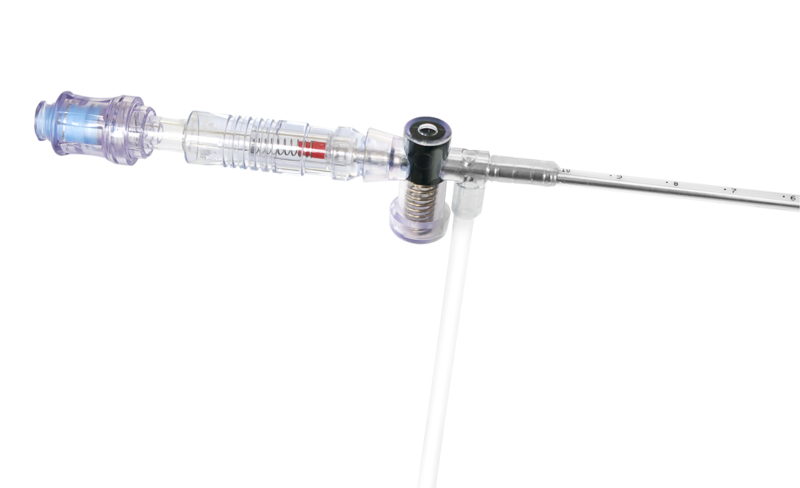
The red indicator is pushed back by tissue resistance and returns to its original position once the pleural cavity is reached — visual confirmation of placement.
No valve switching
The automatic three-way valve lets you aspirate fluid or air and transfer it straight into the collection bag by simply depressing the syringe.
Eliminates connection errors
The design prevents incorrect connections when attaching syringes or drainage bags.
Multiple application options
Fluid or air can be aspirated directly through either the puncture needle or the catheter.
Radiopaque Mini-Drain
The radiopaque catheter is designed to prevent tissue occlusion during aspiration and can remain in place for up to 30 days for repeated drainage.
From puncture to repeated drainage
Puncture
Insert the safety puncture needle. Its atraumatic tip stays protected inside the blunt cannula as it passes through tissue.
Confirm
The red color indicator returns to its original position, confirming entry into the pleural cavity.
Aspirate & collect
Draw fluid or air with the syringe, then depress it to transfer into the 2,000 mL bag. No manual valve switching is required.
Leave in place
Remove the needle and keep the catheter as a Mini-Drain for up to 30 days*. Subsequent drainages use the same catheter.
Pleura-safe® in use
Three patented safety valves
At the puncture needle
Self-sealing, for use with a Luer-Lock syringe.
Directly on the catheter
Self-sealing design.
Three-way valve
Automatic operation with a foolproof design to prevent incorrect handling.
Device selection by treatment period
Pleura-safe® sits between a simple one-time thoracentesis set and a pigtail catheter — intended for repeated drainage over several days to weeks.
Jelco IV set
Jelco + extension tube + 3-way valve
Suited to a one-time puncture due to its low cost. Each reaccumulation requires a new puncture and a new set.
Pleura-safe®
Safety needle + 8 Fr catheter + automatic valve
Low cost for short- to medium-term drainage. Repeated drainage through one catheter over the treatment period.
Pigtail catheter
Small-bore ICD, Seldinger technique
An established option for continuous drainage, at a higher cost. Insertion runs needle → guidewire → dilator → catheter.
| Criteria | Jelco IV set One-time puncture |
Pleura-safe® Short to medium term |
Pigtail catheter Mid to long term |
|---|---|---|---|
| Primary use | Single thoracentesis / aspiration | Repeated drainage over a short-to-medium period | Continuous drainage of pleural fluid / air |
| Recommended use period | Single procedure only | ✓Up to 30 days* | Typically several days, depending on indication |
| Stays in patient after puncture | ✕No | ✓Yes | ✓Yes |
| Repeated chest puncture needed | ✕Yes, if fluid reaccumulates | ✓No — one insertion, repeated drainage | ✓No |
| Insertion method | Direct needle / cannula puncture | Percutaneous, Veress-type safety needle | Seldinger: needle → guidewire → dilator → catheter |
| Surgery required | No | No | No open surgery |
| Invasiveness | Very low for a single procedure | ✓Low | Moderate |
| Protection against deep needle penetration | ✕Limited | ✓Safety mechanism + color indicator | Standard placement technique |
| Catheter | Short IV catheter | 8 Fr, radiopaque | Usually 8–14 Fr |
| Closed system | Depends on configuration | ✓Yes | Usually, depending on setup |
| Valve | ✕Manual 3-way, switching required | ✓Automatic 3-way, no switching | ✕Usually manual stopcock |
| Drainage bag included | Usually separate | ✓2,000 mL included | Usually separate system |
| Procedure complexity | Low | ✓Low | Moderate |
| Staff requirement | Low per procedure, rises with repeats | ✓Low — simple handling | Moderate |
| Patient burden | ✕High if repeated punctures are required | ✓Low | Moderate |
| Cost | Lowest per puncture; adds up with every repeat | ✓Low for short-to-medium term | Higher, with more procedure involvement |
| Typical use | One-time puncture | ✓2–30 days of repeated drainage | Mid- to long-term continuous drainage |
* Indwelling time depends on the clinical indication and the manufacturer's instructions for use.
Cost per procedure and cost per treatment period
A Jelco set has the lowest cost for a single thoracentesis. If the effusion reaccumulates, each further drainage requires a new procedure with the items listed here. For repeated drainage, the relevant figure is the total cost over the treatment period.
Contents of one kit
Product information for healthcare professionals
Contact Allomed Asia for the instructions for use, technical specifications, pricing or a product demonstration.
Contact us →